

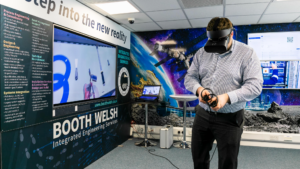
From VR to Reality: Making Digital Tools Work on Real Projects
From digital twins to VR training and energy dashboards, there’s a lot of noise around “digital transformation” just now.
But how much of it is being used in real projects?
We caught up with Stephen Cook, from our Technology Development team, to talk about how these tools are being applied in practice, and where they’re making a difference.
Q: First off, what do you do day-to-day?
A: I’m mostly focused on 3D development and software, so things like design visualisation, VR training, and digital twins.
In simple terms, it’s about helping clients see and understand what they’re building, and how it’s going to work, before it’s there.
Q: And is that quite niche, or does it apply across the board?
A: Honestly, it applies pretty much everywhere.
Any time someone’s building a new plant or upgrading something, there’s value in being able to visualise it properly. Same with training or improving processes, there’s always something we can support with.
We’ve done work across pharma, aerospace, food & drink, even smaller organisations. The problems are usually quite similar, even if the sectors are different.
Q: What would you say makes Booth Welsh different in this space?
A: It’s the fact we can do it alongside the main project.
There are companies out there that just do VR or just do digital twins, but they’re not delivering the engineering as well.
Because we’re already involved in the project, we can build the tech in as we go. It’s not something separate or bolted on at the end.
Q: What are clients actually coming to you for just now?
A: A lot of the time, it’s the newer stuff that catches attention, things like:
- 3D visualisation
- VR environments
- Digital twins
- Energy dashboards
That’s usually what gets people interested in the first place.
Q: And what problems are they actually trying to solve?
A: Energy is a big one.
A lot of clients don’t really know where their energy is going, or when they’re using the most of it.
Once you give them that visibility, they can start making better decisions. It might be shifting when they run certain processes or just understanding what their biggest users are.
So it’s not always about cutting energy, sometimes the solution is just using energy more efficiently.
Q: Can you give an example of how the visualisation side helps?
A: Yeah, one example was a facility layout where we built a full 3D model before anything was installed.
That let the client figure out:
- Where equipment should go
- How people would move around the space
- How workflows would actually function
It’s a lot easier to make those decisions when you can see the practices in action, rather than trying to imagine it from drawings.
Q: And where does VR come into that?
A: Training, mainly.
You can put someone into a virtual version of the plant and let them walk through it, learn processes, and even deal with things going wrong.
We can build in scenarios that would be difficult, or unsafe, to replicate in real life. So they’re much better prepared before they ever step on site.
Q: Do clients fully understand that value upfront?
A: Not always.
Integrated technology is still quite new for a lot of people, so expectations can be a bit unclear. One thing that does surprise people is how quickly we can turn things around, we’ve built up templates and ways of working that let us move pretty fast.
We’re also always happy to carry out demos and supported with the DPMC facility, which helps give clients a clearer picture of what to expect from the outset.
Q: What do clients tend to underestimate?
A: Probably two things.
One is their energy usage, as it’s often higher or more inconsistent than they expect.
The other is the effort needed to pull everything together, especially for visualisation. Even getting the right 3D models can take time if they’re not readily available.
Q: How do clients usually discover this capability?
A: A lot of it comes from seeing the potential solution & technology in action.
That might be:
- At events
- Through demos
- Or just being shown it as part of another project
Once people see the possibilities with incorporating newer tech solutions, it tends to click quite quickly.
Q: Is there anything we should be talking about more as a business?
A: Probably that it’s practical, and cost-effective.
We’re not building experimental tech. This is stuff that can be used right now, on real projects.
We also try to keep costs down where we can, for example, using open-source tools so clients aren’t tied into expensive licences.
Final Thought
A lot of digital capability still gets treated as a “nice to have.”
But when it’s built into a project from the start, not added on later, that’s when it really starts to deliver value.
If you’re looking to embed technology into your operations but aren’t sure where to begin, or what solution is right for you, our Technology Development team would be happy to support and guide you through the process.